
How Long Do Brain Implants Last? Paradromics vs. Neuralink

- Paradromics reported more than 4 years of stable neural recordings in sheep on October 8, 2026, one of the longest public durability results in the field.
- Neuralink says 18 of the 20 participants after its first patient had higher signal quality, and its software now holds calibration for weeks or even months.
- The longest-running human implant passed 9 years by May 2024 and is still going, and the next big answers will come from people in Neuralink and Paradromics trials.
Picture two sheep, each carrying a set of hair-thin electrodes in its brain, and those electrodes still picking up clear neuron signals four years after surgery. That is what Paradromics reported on October 8, 2026, and it is one of the longest public durability results any brain implant company has shared. It also gives us a great reason to look at how long brain implants last today, from the Utah array record in people to the progress Neuralink has made with its flexible threads since its first patient.
What Paradromics announced
Paradromics, an Austin, Texas company building a brain implant called Connexus, said two sheep implanted with its cortical modules kept stable recordings for 4 years. A cortical module is a small array of microwires, each thinner than a human hair, that presses into the outer layer of the brain to pick up individual neurons firing. The company says the modules in the sheep are representative of the electrode technology in the human Connexus device.
The measure Paradromics tracked was spike signal-to-noise ratio, which compares the size of a neuron's electrical pulse with the background hiss around it. If that ratio falls, the software can no longer tell one neuron from another, and control gets worse. Paradromics says the ratio held steady in both animals, the arrays did not move, and the sheep stayed healthy. A second group of six sheep carrying the full implant has shown stable signal quality for nearly 2 years.
Chief Medical Officer Stephen Ryu summed up why the company ran the study:
Durability may be the most important factor for a technology that's meant to be widely adopted.
The release does not include electrode counts or decoding scores, and the data come from animals. Its Connect-One early feasibility study, the company's first human trial, is already underway, with the first participant implanted in June 2026, so the big question now is whether the sheep results hold up in people.
Paradromics shared the result on X the same morning:
Performance or longevity. For years, it seemed like the field of BCI would have to choose between the two.
- Paradromics Inc. (@paradromics) October 8, 2026
Our accumulating preclinical data suggests otherwise: four years of stable neural recording and decoding in large animal models, with steady spike SNR and no electrode array migration.
Why lifespan decides who can get an implant
Implants that press electrodes into the brain, like Connexus, the N1, and the Utah array, require opening the skull, so a device that fails after a few years means another operation for someone who is already paralyzed. Signals also fade for a biological reason. The brain treats an electrode as an intruder, and the immune response around it can wrap the wire in tissue that muffles nearby neurons. A May 2024 news article from the Institution of Mechanical Engineers described the core challenge as keeping an implant in place without damaging tissue, triggering a chronic immune response, or letting the device degrade.
Regulators will weigh that lifespan before approving any implant for sale. A device meant for thousands of people needs evidence that it keeps working for years, and that evidence takes years to collect. Our explainer on going from FDA human trials to a device regular people can get covers that path in more detail.
The human record so far
The longest human data come from the Utah array, a small square of 100 rigid spikes made by Blackrock Neurotech and used in academic trials such as BrainGate. Nathan Copeland, who was paralyzed from the chest down, holds the record for the longest-running implant, at about 9 years as of May 2024 and past 10 years by 2025.
Ian Burkhart held the previous record. He received his implant in April 2014 and kept it for more than 7 years until August 2021, when an infection developed where its cable passed through his scalp and it was removed. The Utah array is cleared by the FDA only for implantation of 30 days or less, so every multi-year case so far has happened inside a research study.
The chart below lines up the longest published figure from each group:
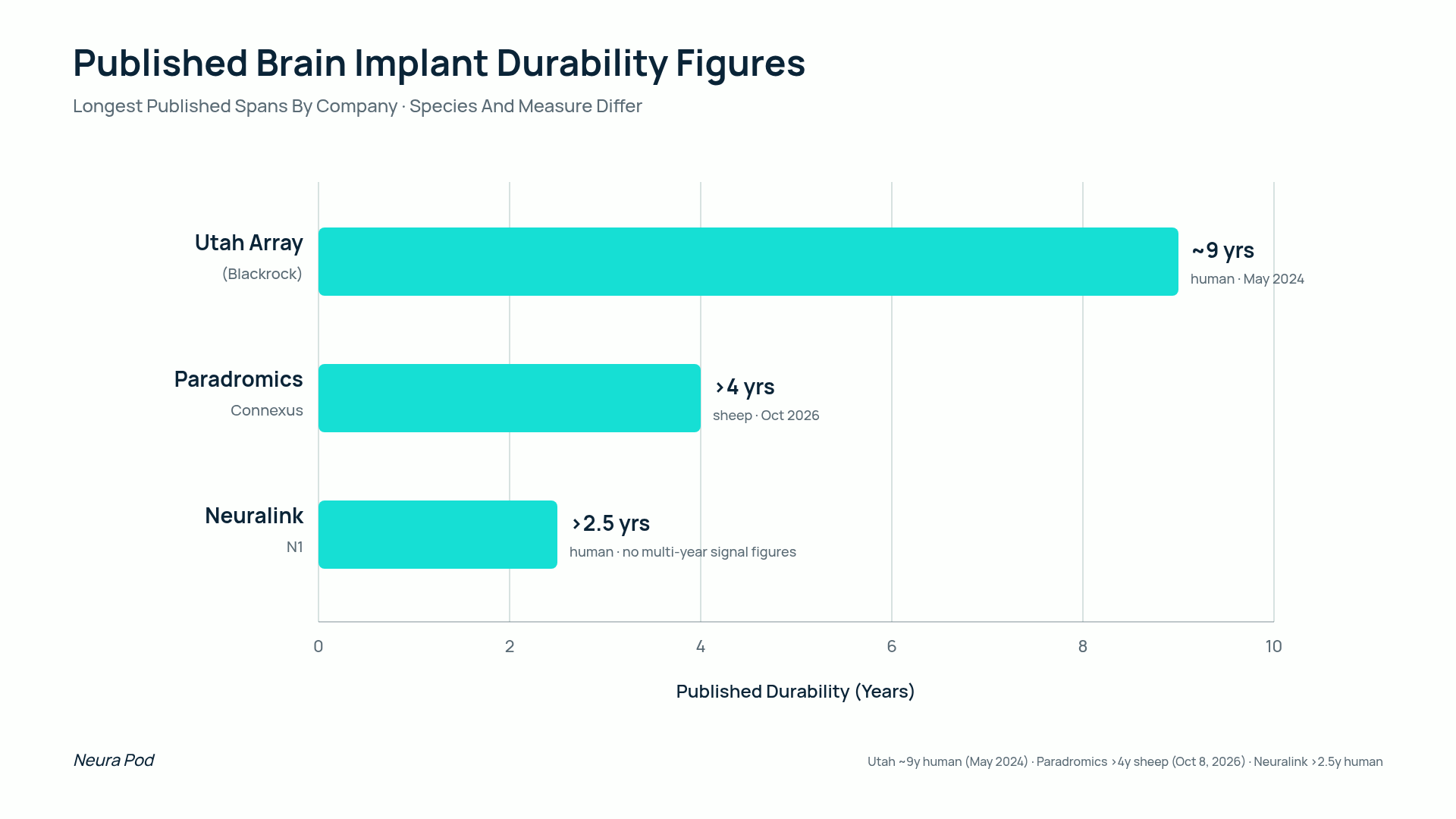
- Utah array (Blackrock Neurotech): about 9 years in one person as of May 2024.
- Paradromics Connexus electrodes: more than 4 years of stable signals in two sheep, announced October 8, 2026.
- Neuralink N1: more than 2.5 years in its first patient, with multi-year signal figures still to come.
The comparison has limits, because each company measures different things in different species. Our BCI companies compared page lays out how the devices differ in design.
What Neuralink has disclosed about its threads
Neuralink takes a different approach from rigid arrays. Its N1 implant uses flexible threads carrying about 1,000 electrodes in total, which a surgical robot stitches into the motor cortex, the strip of brain that plans movement. Flexible threads move with the brain and are meant to cause less tissue damage than rigid spikes, but they can also slide back out.
That happened to its first patient, Noland Arbaugh, who received his implant in January 2024. In a May 2024 update, Neuralink wrote that in the weeks after surgery a number of threads retracted from the brain, which reduced the number of working electrodes and lowered his cursor speed. The company changed its recording software to be more sensitive and said his performance later exceeded where it started.
In its January 2026 post marking 2 years of human trials, Neuralink said that Noland's case taught it surgical and postoperative changes, and that 18 of the 20 participants after him had higher signal quality. It also said it was exploring mechanical features to improve thread retention and planned to raise the electrode count from 1,000 to 3,000. The same post reported zero serious device-related adverse events.
How Neuralink is working around signal drift
Short-term drift, the day-to-day shift in which neurons each electrode hears, is a separate problem from long-term decline, and Neuralink has published more about it. Its October 1, 2026 engineering post said participants have streamed over 50,000 hours of unlabeled neural data, enough for Neuralink to start pretraining models, and the encoders behind its reported results were pretrained on thousands of hours from a single participant. Some decoders, the software that turns brain signals into cursor movement, then kept working for over 3 weeks without recalibration. One participant still had usable control from a calibration recorded 20 months earlier. We broke down that post in Neuralink's 11.32 BPS record.
Software like this stretches the useful life of an implant whose signals shift over time, while better thread retention keeps more electrodes close to the neurons in the first place. Together with Paradromics' animal data, both lines of work are chipping away at the same question of how many years one implant can serve a person.
What to watch next
The next proof will come from people. Paradromics has to show its sheep results hold up in Connect-One participants, and Neuralink's earliest patients are approaching 3 years with their implants. A Neuralink paper or update with signal quality plotted over years, for all participants, would be the first direct answer to how long the N1 lasts. For the full list of who has an implant and when, see the Neura Pod Neuralink patient table, and for terms like electrode and decoder, the key terms glossary.
Summary
Paradromics showed more than 4 years of stable recordings in sheep, which puts real animal data behind the idea that an implant can keep working for years. Neuralink, meanwhile, used what it learned from its first patient to raise signal quality for nearly everyone who came after him. The next milestone is long-term human data from Neuralink and Paradromics trials, which will show how many years people can count on one of these devices.
Follow @NeuraPod for Neuralink news as it happens.







