
Neuralink Blindsight vs. PRIMA: Two Ways to Restore Sight With a Chip

Neuralink's Blindsight is built to restore sight to people whose eyes or optic nerves no longer work, by stimulating the brain's visual cortex directly, and Elon Musk said in August 2026 that the first implants would come within 6 to 12 months. Science Corporation's PRIMA, a retinal chip that works inside the eye, showed on October 5, 2026, that the reading vision it restored in people with macular degeneration held at 3 years. Those results are the strongest evidence yet that people will learn to use artificial vision, the same skill every Blindsight user will build.
Two announcements in eight days
Science Corporation was founded in 2021 by Max Hodak, who co-founded Neuralink and served as its president before he left. On October 5, his company presented 36-month results for PRIMA at the EURETINA Congress in Vienna, a yearly meeting of European retina specialists. Eight days later, Hodak told the TechCrunch Disrupt stage in San Francisco that the same chip had gone into its first patient with Stargardt disease, an inherited condition that destroys central vision and has no approved treatment.
The Stargardt patient was implanted in May 2026 in a trial called PRIMAlia at Sydney Eye Hospital in Australia, supervised by Dr. Matthew Simunovic. Science says he saw a letter at his first rehabilitation session and read a whole word at his second. TechCrunch reports that about 150,000 people worldwide have lost vision to the disease.
Both announcements arrive as Neuralink prepares its own first vision implant. Hodak's company works on the eye, while Neuralink's Blindsight goes to the brain, which lets it aim at forms of blindness that no retinal chip can treat.
How PRIMA works
PRIMA is a wireless chip measuring 2 millimeters by 2 millimeters and 30 microns thick, thinner than a human hair. A surgeon slides it under the retina, the light-sensing layer at the back of the eye, in the spot where the photoreceptors (the cells that turn light into nerve signals) have died. The patient wears glasses with a camera that projects near-infrared light onto the chip. The chip is photovoltaic, meaning it turns that light into electrical current the way a solar panel does, and the current stimulates the surviving retinal cells beneath it. Those cells send the signal down the optic nerve as normal.
The device was first developed by Daniel Palanker at Stanford, and Science bought it from the French company Pixium Vision in April 2024. The glasses include a zoom, so patients can enlarge a word until the chip can resolve it. Hodak described the result to TechCrunch as black and white, high contrast, and sharp enough to read a couple of letters at a time.
What 3 years of data show
The main PRIMA trial, called PRIMAvera, implanted 38 people with geographic atrophy, a late form of age-related macular degeneration that leaves a blind patch in the center of vision. It ran at 17 clinical sites in five European countries, and its 12-month results appeared in the New England Journal of Medicine in October 2025. At 12 months, 80% of patients had gained at least 10 letters on a standard eye chart, the threshold doctors treat as a meaningful change.
The new 36-month numbers, presented by Dr. Mahi Muqit of Moorfields Eye Hospital in London, cover a smaller group. Science reports 27 patients evaluable for safety and 18 for vision at 3 years. Those 18 gained an average of 29 letters, close to 6 lines on the chart, and 14 of them gained at least 15 letters.
"Three years after implantation, the patients who gained vision have kept it, even improved it." Dr. Mahi Muqit, Moorfields Eye Hospital
Science reported no new safety problems between month 12 and month 36. Most serious side effects came in the first 6 months after surgery, and Muqit described them as known risks of operating under the retina. The patients' remaining natural vision in the implanted eye stayed stable. Hodak put the trend this way:
"In clinical trials, PRIMA is working better at month 36 than it did at month six." Max Hodak, CEO of Science Corporation
Europe has already acted on the data. On July 22, 2026, PRIMA received a CE mark, the approval needed to sell a medical device in the European Union, covering 30 European countries. In the United States, the FDA has given it Breakthrough Device designation and, in spring 2026, Humanitarian Use Device designations for geographic atrophy and Stargardt disease, but Science still needs a formal FDA approval before American patients outside a trial can get it.
Why Blindsight could reach more people
PRIMA depends on the rest of the eye. It replaces only the dead photoreceptors, so the inner retina and the optic nerve still have to carry the signal to the brain. That limits it to diseases of the outer retina, and it rules out people blinded by glaucoma, optic nerve injury, or the loss of both eyes.
Blindsight skips the eye completely. Neuralink plans to place an implant in the visual cortex, the area at the back of the brain that builds what a person sees, and feed it images from a camera worn on glasses. The implant would stimulate neurons with electrical pulses so the person sees points of light, called phosphenes, arranged into a picture. At Neuralink's 2022 show-and-tell event, Musk said the approach could work even for people born blind because "the visual part of the cortex is still there." The Neura Pod Neuralink FAQ and key terms glossary cover the parts of the device in more detail.
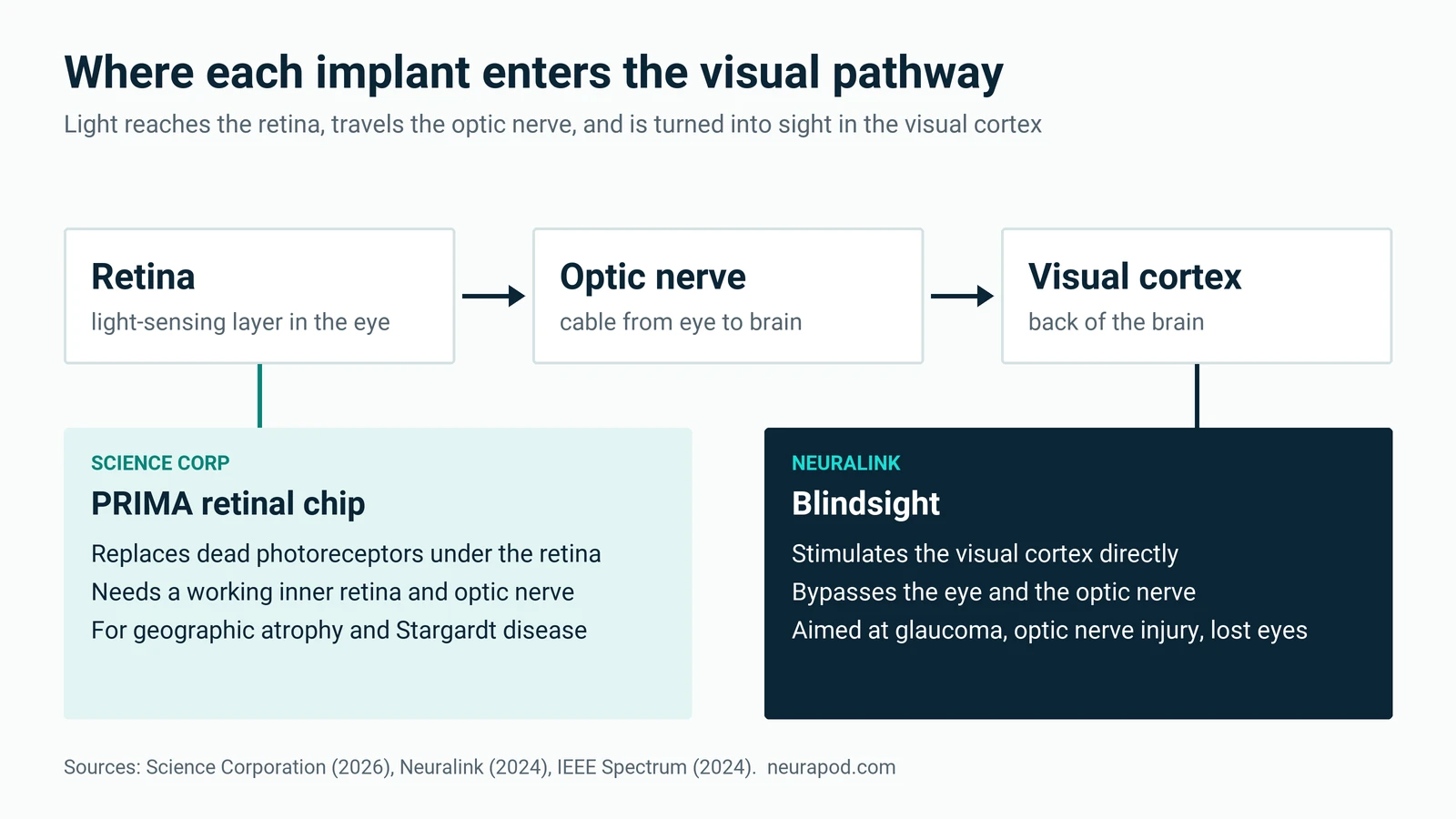
The two devices compare like this:
- Placement: Blindsight goes into the visual cortex through brain surgery; PRIMA goes under the retina in an eye operation of about an hour.
- Who it can help: Blindsight is aimed at people with no light perception at all, including people who have lost both eyes; PRIMA needs a working optic nerve and inner retina.
- Track record: Neuralink has already implanted its N1 brain chip in more than 20 people in its Telepathy trials; PRIMA has a published trial with 3 years of follow-up.
- Regulatory status: Blindsight received FDA Breakthrough Device designation, which is meant to speed review, on September 17, 2024; PRIMA is approved for sale in Europe.
When the first Blindsight implant is expected
Neuralink has been preparing Blindsight for its first human since the FDA designation in 2024. In January 2026, Musk said the company was ready for its first Blindsight implant once regulators signed off. On August 4, 2026, he gave the current window:
"In the next 6-12 months, we'll be doing our first implants for vision." Elon Musk, as reported by Pulse in August 2026
That puts the first Blindsight patient as early as the start of 2027, and the next milestone to watch for is Neuralink naming that participant. Our earlier post on what to expect from the first Blindsight implants covers the trial design Neuralink has described.
What PRIMA's results mean for Blindsight
PRIMA's data are good news for Blindsight because they show that people will put in the months of rehabilitation that artificial vision needs. PRIMA patients learn to use the chip in rehabilitation sessions after surgery, as the Stargardt patient's first two sessions show, and the trial's average gain kept rising from 24.5 letters at 12 months to 29 at 36 months. Blindsight users will also train their brains to read phosphenes, and PRIMA shows that this kind of practice kept improving results into the third year.
Blindsight also has the higher ceiling. A retinal chip can only work with the eye a patient still has, while an implant in the visual cortex takes its picture from a camera. When Blindsight received its FDA designation, Musk wrote on X that the first vision would be low resolution, "like Atari graphics," but could eventually be "better than natural vision," including sight in infrared, ultraviolet, or radar wavelengths. Science is improving PRIMA too, and Hodak told TechCrunch that a next-generation version with smaller electrodes and a wider field of view should reach humans within the next year. Neuralink's next milestone is its first Blindsight patient, and our September 2026 update tracks every step the company has announced so far.
Sources
- Neuralink: Breakthrough Device Designation for Blindsight (September 17, 2024)
- Neuralink: Two Years of Telepathy (January 28, 2026)
- Pulse: Musk on the first Blindsight implants (August 4, 2026)
- India TV News: Neuralink ready for first human implant of Blindsight (January 29, 2026)
- IEEE Spectrum: Neuralink's Blindsight and Musk's vision claims (September 27, 2024)
- Science Corporation: 36-month results of the PRIMA clinical trial (October 5, 2026)
- Science Corporation: first patient with Stargardt disease using PRIMA (October 13, 2026)
- TechCrunch: Science Corporation implants its vision-restoring chip in its first Stargardt disease patient (October 13, 2026)
- Science Corporation: European commercial launch of PRIMA (July 22, 2026)
- Eyewire News: Science Corporation launches PRIMA in Europe following CE mark (July 22, 2026)
Follow @NeuraPod for Neuralink news as it happens.







