
Neuralink Brain Chip vs Other BCIs: Unique Differences Explained
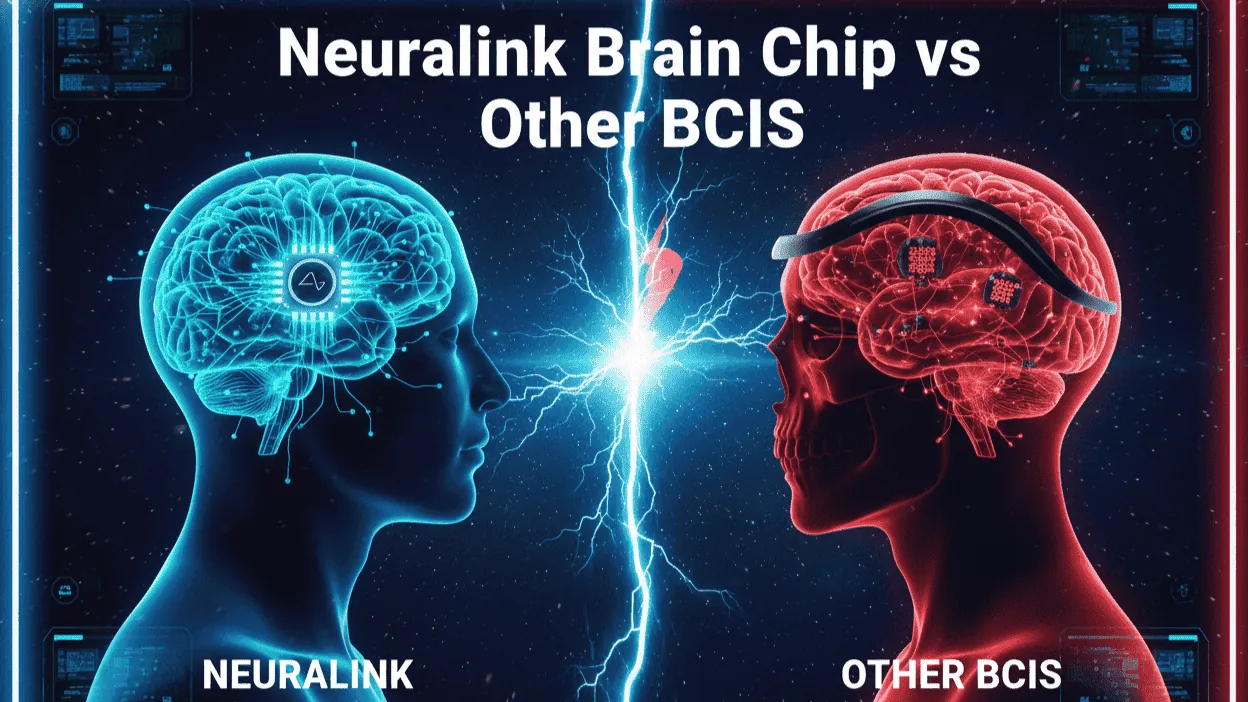
- Neuralink's N1 implant uses 1,024 electrodes on flexible threads, far more recording sites than Synchron's 16-channel Stentrode or Blackrock Neurotech's 96-channel Utah Array.
- The N1 is fully wireless and needs no connector through the skin, unlike Blackrock's system.
- Neuralink participants reach a median of about 10 bits per second on its cursor test, with a record of 11.32 set in 2026.
Electrode design
Neuralink's N1 implant uses 64 threads with 16 electrodes each in early implants, and 128 thinner threads with 8 electrodes each in later ones, for 1,024 electrodes in the motor cortex either way, according to the PRIME brochure and Neura Pod's FAQ. This captures individual neuron spikes for cursor control and physical tasks. Synchron's Stentrode uses 16 electrodes placed inside a blood vessel, which picks up broader signals suited to basic clicking. Blackrock's Utah Array has 96 to 128 rigid silicon electrodes that pierce the brain surface, and its signals can degrade over time.
Paradromics' Connexus has 421 electrodes. After a temporary recording in 2025, its first long-term patient was implanted in June 2026 and produced real-time speech in September 2026, as covered in Neura Pod's September 2026 update. Precision Neuroscience uses a thin film on the brain surface with many contacts, but it does not reach individual neurons below the surface.
Neuralink's design has logged more than 15,000 hours of use across 13 implants as of late October 2025, and Neuralink reported zero serious device-related adverse events as of January 2026.
Robotic implantation
Neuralink uses the R1 surgical robot to insert threads with micron-level accuracy that human surgeons cannot match. The whole procedure includes a craniotomy, the creation of a small opening in the skull, and the robot positioning electrodes for insertion into the brain tissue. The electrode insertion takes under 30 minutes, while the whole surgery currently takes several hours. The team is working on reducing the time the patient is under general anesthesia. Elon Musk has said robots will surpass top surgeons within years.
Competitors take different routes. Synchron inserts its device by catheter through the jugular vein, avoiding a craniotomy but limiting placement to blood vessels. Blackrock requires manual surgery and a pedestal connector through the scalp, which carries an infection risk. Paradromics and Precision both open the skull but do not use a robot like Neuralink's.
UK patient Paul controlled a computer hours after surgery in October 2025.
Performance in trials
Neuralink decoders reach a median of about 10 bits per second and a record of 11.32 bits per second, according to Neuralink's October 2026 update. In the robotic arm study, ALS patient Nick Wray fed himself. Patients play games like Dawn of War, and Noland Arbaugh studies calculus and gives speeches using the implant.
Synchron users text at lower speeds because of the device's few channels, and Blackrock users have relied on wired connections that limit mobility. Precision has focused on brain mapping rather than fast control.
Neuralink's trials now include sites in Canada and the UK, with a UAE site recruiting. In November 2025, Elon Musk shared a report that Noland hopes to receive a second implant below his spinal injury.
Stimulation and scale
The N1's chips can stimulate as well as record. Neuralink plans to use that for Blindsight, a vision implant that would stimulate the visual cortex; human trials have not started. Synchron's device records only.
Neuralink's roadmap targets 25,000 channels per implant by 2028. A $650 million Series E in June 2025 funds the work, and internal projections reported by Bloomberg target 20,000 implants a year by 2031.
This article was first published in October 2025 and corrected in October 2026; the latest patient count is on the patient table.








