
Can Patients Control Computers with Neuralink? Real Examples
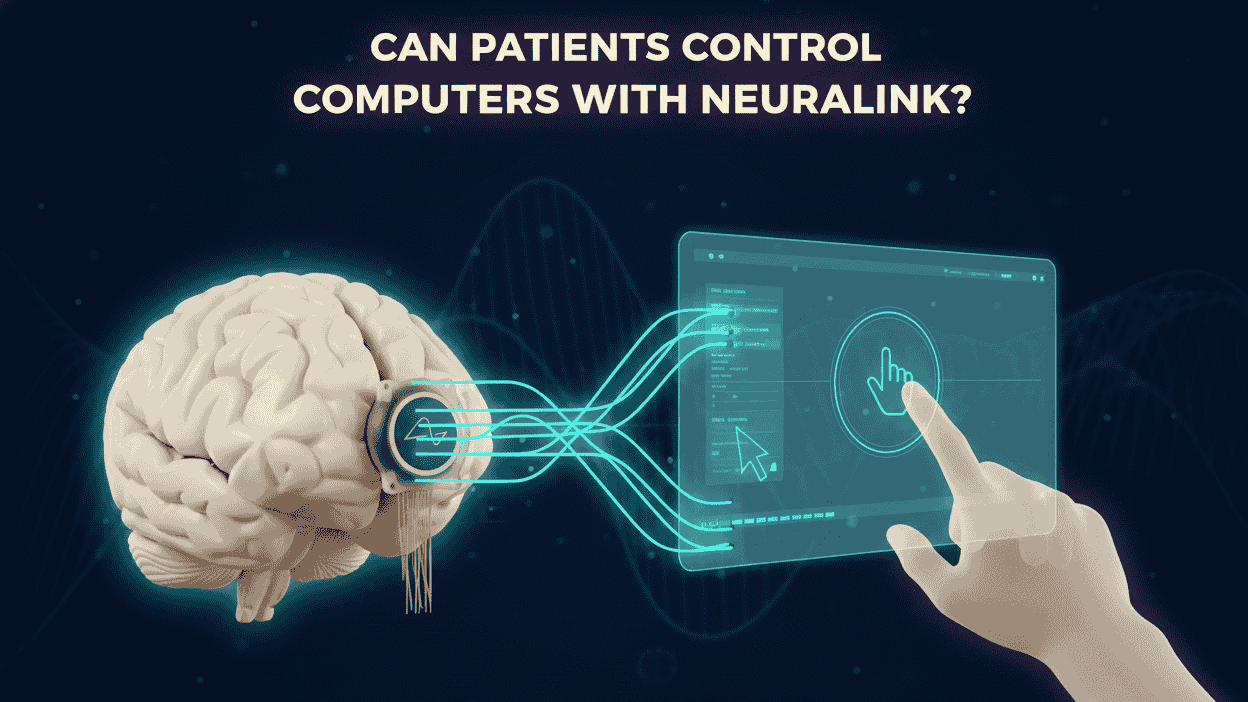
- Neuralink patients control computers using only their thoughts through the Telepathy device in the PRIME Study.
- Noland Arbaugh moves cursors, plays chess, and browses the web at speeds matching able-bodied users.
- UK patient Paul controlled a computer cursor hours after his October 2025 implant surgery.
The technology behind thought control
Neuralink's implant reads neuron signals from the motor cortex. The N1 device has 1,024 electrodes on 64 threads in early implants and 128 thinner threads in later ones, inserted by the R1 robot. The electrodes pick up activity as patients imagine movements, and machine learning decoders turn it into cursor actions or keystrokes.
Patients connect wirelessly to phones or computers through the Neuralink app. Calibration takes minutes, and performance improves with use. Participants reach a median of about 10 bits per second, matching able-bodied mouse users, according to Neuralink's October 2026 update. Participants have streamed over 50,000 hours of neural data, and Neuralink reported zero serious device-related adverse events as of January 2026.
Noland Arbaugh: the first patient
Noland Arbaugh received the first human Neuralink implant in January 2024, years after a 2016 accident left him with quadriplegia. Soon after surgery, he moved a cursor on screen. Today he browses Reddit, watches YouTube, and plays online chess by thinking.
He set a world record for brain-computer interface cursor speed in his first sessions. Despite early thread retraction, software updates restored and then improved his cursor performance. Noland now studies neuroscience and gives speeches.
In November 2025, Elon Musk shared a report that Noland hopes to receive a second implant below his spinal injury to help restore leg movement.
Paul: instant control in the UK
Paul, who has motor neurone disease, became Neuralink's first UK patient in October 2025 at University College London Hospitals. As part of the GB-PRIME Study, Paul controlled a computer cursor hours after implantation, Neuralink reported.
Videos show his cursor moving smoothly across the screen. Paul now plays video games and handles daily tasks. His implant marked Neuralink's expansion beyond North America; trials also run in Canada, and a UAE site is recruiting.
More patients
Alex, the second PRIME participant, controls computers and, in the CONVOY Study, robotic arms. He has played rock-paper-scissors with a robotic hand and performs precise grasps.
ALS patient Brad edits videos, chats with AI, and races his family in Mario Kart faster than he could with eye tracking. Veteran RJ, the fifth implant, emails and games. Audrey Crews wrote her name after 20 years of paralysis. Canadian patients in Toronto joined in 2025.
What comes next
Neuralink's roadmap called for about 3,000 channels in 2026 and about 10,000 in 2027, and a 3,000-channel implant was disclosed in September 2026. The VOICE trial is testing speech restoration, and Blindsight would target vision. Jon Noble, a UK participant, wrote in December 2025 that more than 10,000 people were on the US waiting list.
This article was first published in October 2025 and corrected in October 2026; the latest patient count is on the patient table.








