
What If Corrupted Data Hits Neuralink? Risks and Solutions
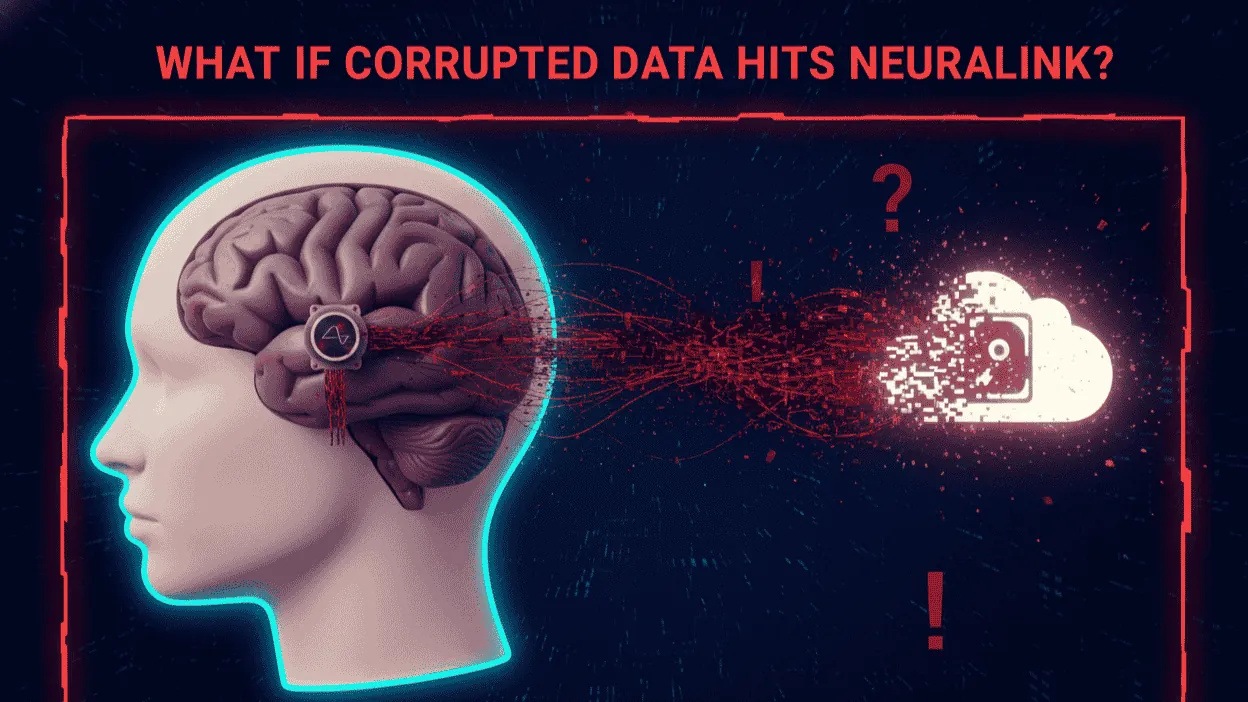
- Neuralink's implant records from 1,024 electrodes, so losing or misreading some channels does not stop the decoder from working.
- Corrupted data could come from noise, hardware problems, threads pulling out of the brain, or, in theory, deliberate interference with the wireless link.
- Neuralink reported zero serious device-related adverse events as of January 2026, when it had 21 participants.
What corrupted data means for an implant
The N1 implant records neuron spikes through 1,024 electrodes on flexible threads and sends the data wirelessly to a computer, where software turns it into actions like cursor movement. Corrupted data means signals that are distorted by noise, hardware failure, software errors, or outside interference.
The brain is a noisy place to record from: background electrical activity and small movements of the implant both add errors. The implant's chips amplify and filter each channel, and machine learning decoders are trained to recognize the patterns that matter. Recording from many channels also gives redundancy, so the decoder can still work if some electrodes stop providing useful signal.
Possible risks
The clearest example of signal loss happened early. In 2024, many of Noland Arbaugh's threads retracted from his brain weeks after his implant, and his cursor performance dropped. In a robotic arm trial like CONVOY, bad data could in theory cause unintended movements.
Security researchers have also described theoretical attacks on brain-computer interfaces, such as intercepting or spoofing a wireless link, or tampering with software updates. No attack on a Neuralink implant has been publicly reported.
How Neuralink handles signal problems
After the retraction, Neuralink engineers recalibrated Noland's decoder within days through an over-the-air update, boosting bits per second beyond his earlier baseline. After changes made following Noland's surgery, Neuralink reported higher signal quality in 18 of the next 20 participants and says it is still improving thread retention, according to its January 2026 update.
Neuralink describes a patented secure pairing system meant to link the implant only to authorized devices. It has not published the encryption details of its Bluetooth link or how firmware updates are verified.
Results in the trials
Neuralink reported zero serious device-related adverse events as of January 2026, when it had 21 participants. UK patient Paul controlled a computer hours after surgery, and Noland now performs better than before the retraction, studying neuroscience with the implant. In the CONVOY study, Alex Conley controls a robotic arm by thought.
What comes next
Neuralink's roadmap called for about 3,000 channels in 2026 and about 10,000 in 2027; more channels would add redundancy. Neuralink's newer decoders are pretrained on over 50,000 hours of participants' data, which helps them handle day-to-day changes in the signals, according to Neuralink. In November 2025, Elon Musk shared a report that Noland hopes to receive a second implant below his spinal injury to help restore leg movement.
This article was first published in October 2025 and corrected in October 2026; the latest patient count is on the patient table.








