
Neuralink Data Access: Who Can View It at Every Stage?
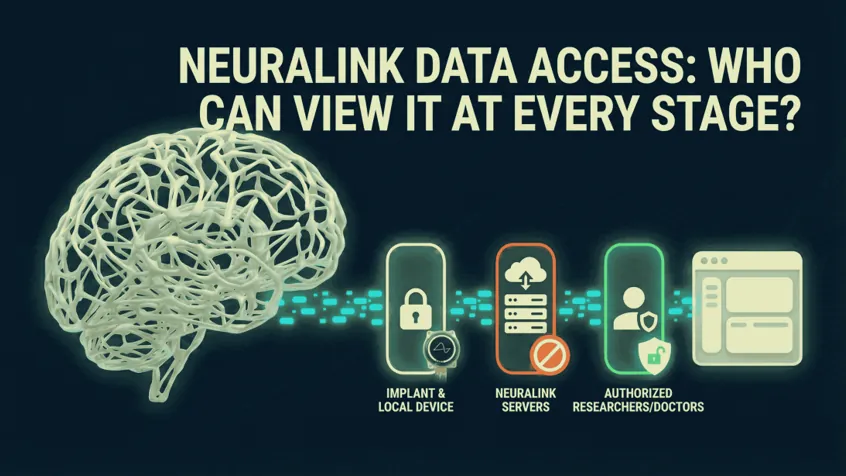
- Patient Registry submissions are reviewed by Neuralink staff to check eligibility.
- During surgery and training, the trial site's surgical team and Neuralink engineers see live neural signals, and patients see their own performance in the N1 app.
- For research, Neuralink analyzes trial data under each trial's protocol and consent forms, and regulators like the FDA can review trial records.
Patient Registry and screening
The process starts with Neuralink's Patient Registry at neuralink.com/trials, where applicants provide contact details, demographics, medical history, and health information. Neuralink staff use this information to assess eligibility for its studies in the US, Canada, the UK, and the UAE.
Neuralink coordinators review submissions with clinicians at trial sites such as Barrow Neurological Institute or University College London Hospitals. Applicants may then be invited to share fuller medical records. Jon Noble, a UK participant, wrote in December 2025 that more than 10,000 people were on the US waiting list.
Surgery
Selected patients sign informed consent forms before the robot-assisted procedure. During surgery at sites like Barrow Neurological Institute, the surgical team checks neural signals to confirm that the 1,024 electrodes on flexible threads (64 threads in early implants, 128 in later ones) are placed correctly in the motor cortex.
Neuralink engineers support the procedure and the R1 robot. After surgery, the implant sends its signals over Bluetooth to the patient's paired device. UK participant Paul gained cursor control hours later, and participants have typically gone home within a day or two.
Training after implantation
Training starts once the implant is activated. Neuralink's engineers and site staff work with live data to calibrate the decoding models, and patients and caregivers see performance in the app, including bits per second and typing speed. Participants have typed at up to 40 words per minute using imagined finger movements, according to Neuralink's January 2026 update.
Participants commit to at least two 1-hour research sessions a week. In the CONVOY study, engineers also monitor robotic arm control. Neuralink pushes software updates over the air.
Long-term research and follow-up
The PRIME study takes about 6 years: 9 at-home and in-person visits over about 18 months, then 20 follow-up visits over 5 years, according to the PRIME brochure. Neuralink researchers analyze the data to evaluate safety and performance, and submitted results from its first three participants to the New England Journal of Medicine.
FDA inspectors can review trial records, and each site's principal investigator reports adverse events. Patients access their metrics anytime but not raw signals, aligning with trial norms. Neuralink reported zero serious device-related adverse events as of January 2026.
Rights and compliance
Neuralink's privacy policy says the company does not sell personal information and that trial data is governed by the trial protocol, informed consent, and, where applicable, HIPAA authorization forms. Privacy requests go to dpo@neuralink.com, and UK forms detail Bird & Bird representation. Colorado and other states have passed neural data laws.
This article was first published in October 2025 and corrected in October 2026; the latest patient count is on the patient table.








