
Neuralink Data Flow vs Non-Invasive BCIs: Rate Comparisons
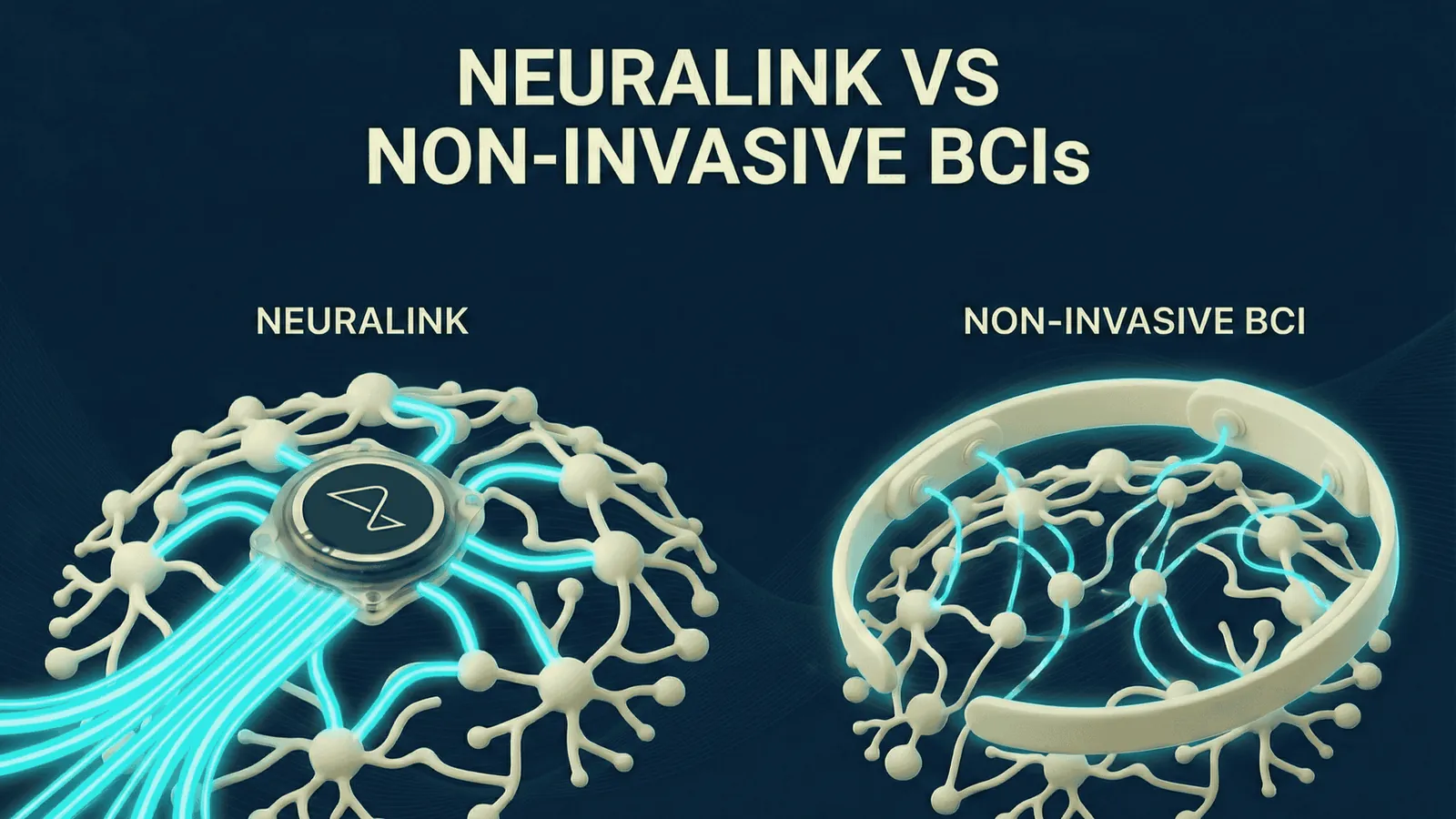
- Neuralink's N1 implant samples 1,024 channels at about 20,000 samples per second each, a raw data rate of roughly 200 megabits per second, far above the 1 to 5 megabits per second of typical scalp EEG systems.
- In usable information, Neuralink participants reach a median of about 10 bits per second on cursor tasks, with a record of 11.32, compared with roughly 0.5 to 2 bits per second for most non-invasive systems.
- The gap comes from recording directly inside the cortex, which avoids the signal loss caused by the skull and scalp.
Neuralink's data flow
The N1 implant has 1,024 electrodes on flexible threads. Each channel is sampled about 20,000 times per second at 10-bit resolution, or about 200 kilobits per second per channel and roughly 200 megabits per second across the array. The implant detects spikes and compresses the data on its chip, then sends it over Bluetooth, which carries about 1 megabit per second to the paired device. Software there decodes the signals in real time to control a cursor or a robotic arm.
The practical measure is bits per second (BPS) of information a user can send. Neuralink's median participant reaches about 10 BPS, and one set a record of 11.32 BPS in 2026, according to Neuralink's October 2026 update. Recording from inside the brain gives far cleaner signals than sensors outside it.
Non-invasive BCIs
Non-invasive brain-computer interfaces use electroencephalography (EEG, electrodes on the scalp), functional near-infrared spectroscopy (fNIRS, which tracks blood oxygen with light), or functional MRI. EEG systems typically use 16 to 256 scalp electrodes sampled 256 to 512 times per second, for raw data rates of about 1 to 5 megabits per second. The skull and scalp weaken and blur the signals.
Effective rates for EEG systems are often measured in bits per minute: advanced systems reach 20 to 50 bits per minute, about 0.33 to 0.83 bits per second, for spelling or cursor tasks. The fastest EEG spellers, which use flickering visual targets, have reached about 5 bits per second in lab settings. fNIRS is slower because blood flow changes lag behind neural activity, and fMRI is too slow and bulky for real-time use. These methods are safer and easier to use, which suits research and consumer products.
Comparison
Neuralink's raw data rate is roughly 40 to 200 times that of typical EEG systems, and it captures individual neurons rather than broad brain rhythms. In usable control, Neuralink participants now reach about 10 BPS, several times the rate of most non-invasive systems. Paradromics, another implant company, claims its device can exceed 200 bits per second in benchmarks.
Challenges
Implanted electrodes can lose signal over time. After changes made following its first participant's surgery, Neuralink reported higher signal quality in 18 of the next 20 participants and says it is still improving thread retention. Power limits how much data the implant can send without heating tissue. Non-invasive systems face noise from muscles and the environment, which keeps their effective rates low.
Neuralink's roadmap called for about 3,000 channels in 2026, about 10,000 in 2027, and 25,000 in 2028, and a 3,000-channel implant was disclosed in September 2026. More channels should raise both raw data and usable speed.
This article was first published in October 2025 and corrected in October 2026; the latest patient count is on the patient table.








