
Neuralink Implantation Alternatives: Emerging Methods Explored
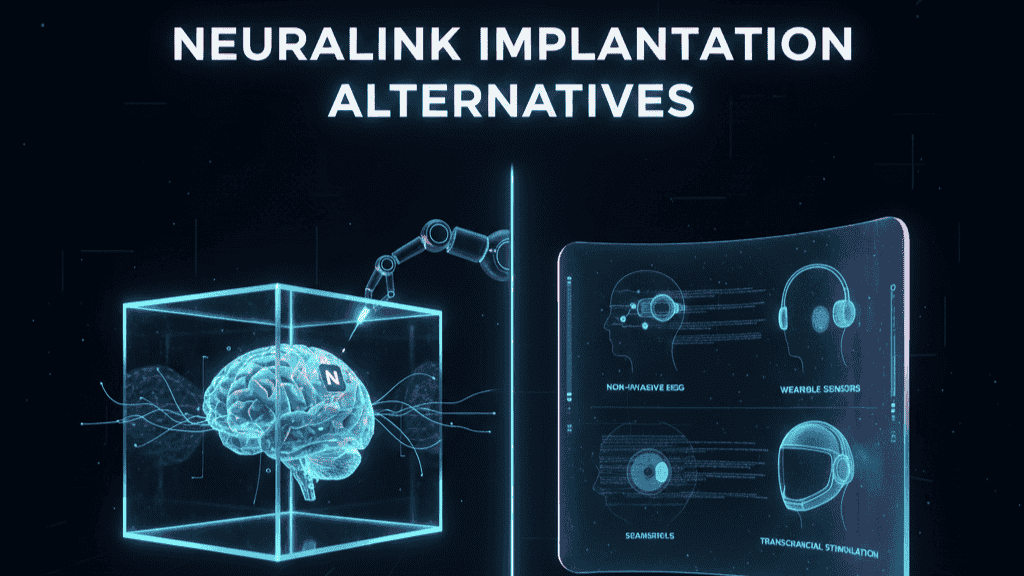
- Synchron's Stentrode is a less invasive alternative to Neuralink: it reaches the brain through a vein in the neck and stays inside a blood vessel.
- Precision Neuroscience places a thin film of electrodes on the brain surface through a slit in the skull, without going into the tissue.
- Blackrock Neurotech's Utah Array and Paradromics' Connexus push rigid electrodes into the cortex, like Neuralink but with different hardware.
Neuralink's method
Neuralink's N1 implant uses the R1 surgical robot to insert flexible polymer threads a few millimeters into the cortex, placing 1,024 electrodes near motor neurons while avoiding blood vessels. Early implants used 64 threads and later ones 128 thinner threads. The coin-sized implant fits in the skull and sends data wirelessly. Participants have reached cursor speeds that match able-bodied mouse users, according to Neuralink's October 2026 update. As of late October 2025, 13 participants were using the device, and Neuralink reported 21 on January 28, 2026. Elon Musk has said human surgeons cannot match the robot's micron-level accuracy for safe insertion at scale.
The thread approach records from more channels than most rivals. Its main known problem is threads pulling back out of the brain, which happened to the first participant in 2024.
Synchron's Stentrode: through a blood vessel
Synchron's Stentrode is placed through a catheter from the jugular vein into the superior sagittal sinus, a large vein on top of the brain. That avoids opening the skull and uses techniques that neurointerventional doctors already know.
In October 2025, Time named Stentrode one of the year's best inventions. Synchron's COMMAND trial met its safety goals in 6 patients, who texted and used iPads by thought with no device-related serious adverse events over a year. Synchron has also connected its system to an OpenAI chatbot. The implant records from 16 channels, far fewer than Neuralink, but enough for communication.
Precision Neuroscience: a film on the surface
Precision Neuroscience's Layer 7 array slides a thin film with 1,024 electrodes onto the brain surface through a slit in the skull less than 1 millimeter wide. The film does not go into brain tissue, which aims to reduce damage and make removal easier.
Precision began temporary human recordings in 2023 and received FDA 510(k) clearance in April 2025 for implants of up to 30 days. It raised $102 million to speed up its trials. Neuralink's threads reach neurons below the surface, which gives finer signals from individual cells.
Penetrating arrays: Blackrock and Paradromics
Blackrock Neurotech's Utah Array uses 96 to 128 rigid silicon needles about 1.5 millimeters long. It has been implanted in dozens of people since 2004 and has supported years of research on computer control.
Paradromics' Connexus has 421 electrodes. Its first recording in a person, during epilepsy surgery in June 2025, was temporary. Its first long-term implant followed in June 2026, and the patient produced real-time speech in September 2026, as covered in Neura Pod's September 2026 update.
Rigid arrays can cause scarring over time, which is one reason Neuralink chose flexible threads.
Where the field is going
Researchers are testing less invasive options, such as arrays placed on top of the brain's outer membrane, but these lack human data. Academic groups at Stanford and UC Davis have shown speech brain-computer interfaces that point toward fully implanted speech devices. Neuralink's roadmap targets about 10,000 channels per implant in 2027.
This article was first published in October 2025 and corrected in October 2026; the latest patient count is on the patient table.








