
Will Neuralink Boost Intelligence? Superhuman Abilities Discussed
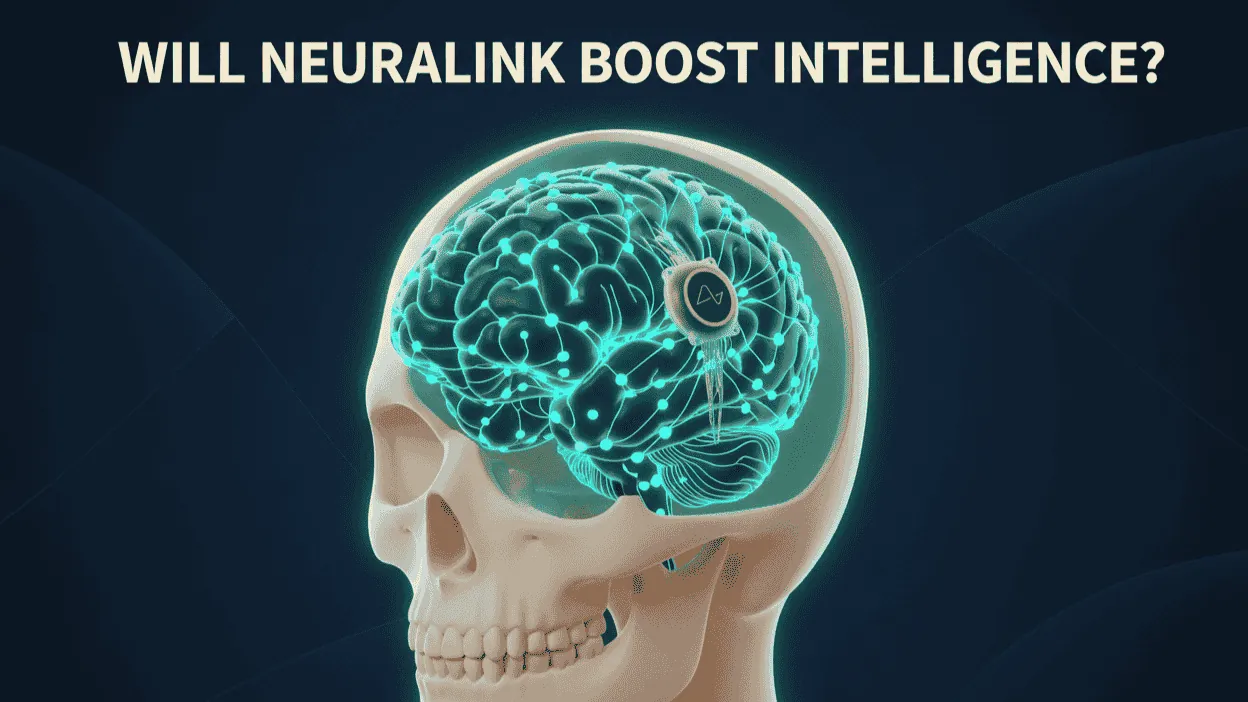
- Elon Musk has said Neuralink could one day enable abilities like infrared or ultraviolet vision and a much faster link between people and AI.
- Today the implant is a medical device in clinical trials for people with paralysis or severe speech loss.
- Musk has said enhancement would be a choice, coming after the medical uses are proven.
Restoration first, enhancement later
Neuralink's N1 implant records from 1,024 electrodes on flexible threads (64 threads in early implants and 128 thinner threads in later ones). Its first job is medical: letting people with paralysis control computers, phones, and robotic arms by thought. Neuralink reported 21 participants on January 28, 2026. In its CONVOY study, Alex Conley was the first to control a robotic arm, and Nick Wray used one to feed himself, according to Neuralink's January 2026 update.
Elon Musk calls this phase one. Phase two would extend the device to healthy people. He describes Neuralink as a "generalized brain interface" and has argued that typing and speaking are a bottleneck between people and computers that a high-bandwidth implant could remove.
Intelligence and AI
Musk's case for boosting intelligence rests on bandwidth, with no change to the neurons. He has argued that as AI surpasses human thinking, people without a faster connection to it risk falling behind, and that an implant could let someone query AI systems like Grok far faster than by typing.
The trials so far measure speed of control. Neuralink's median participant reaches about 10 bits per second on its cursor test, and one set a record of 11.32 bits per second in 2026, according to its October 2026 update. That matches an able-bodied person with a mouse, and it is still far from the "thousands" Musk has talked about. Neuralink's roadmap targets about 10,000 channels in 2027 and 25,000 in 2028.
Superhuman sensory and physical abilities
Blindsight, Neuralink's planned vision implant, would stimulate the visual cortex to restore a basic form of sight, even for some people blind from birth. Neuralink said human trials would start in 2026, and none had launched as of October 2026. Musk has said later versions could add infrared, ultraviolet, or radar vision.
On the physical side, Neuralink has shown a participant moving a Tesla Optimus robot hand. Stimulation in both directions could one day let a user feel a remote robot limb as part of the body, an idea Musk has called "Deus Ex irl." Musk also wrote in October 2024 that Neuralink should prioritize an implant that can eliminate back and neck pain.
Evidence from the trials
Noland Arbaugh was using his implant about 10 hours a day by August 2025, for browsing, studying, and gaming. The VOICE speech trial implanted its first participants in early 2026, and a third participant spoke with a voice decoded from his brain in September 2026. Trials now run in the US, Canada, and the UK, with a UAE site recruiting, and Neuralink raised a $650 million Series E in June 2025. Neuralink reported zero serious device-related adverse events as of January 2026.
What Elon Musk has predicted
Musk links Neuralink's future to xAI and Tesla's Optimus robot. Neuralink intends to work through regulatory approvals and use robotic surgery to cut the procedure to 600 seconds (10 minutes), which would make it accessible to anyone who wants one. None of the enhancement features in this article have been tested in people.
This article was first published in October 2025 and corrected in October 2026; the latest patient count is on the patient table.








