
How Is Neuralink Connected to the Nervous System? Tech Deep Dive
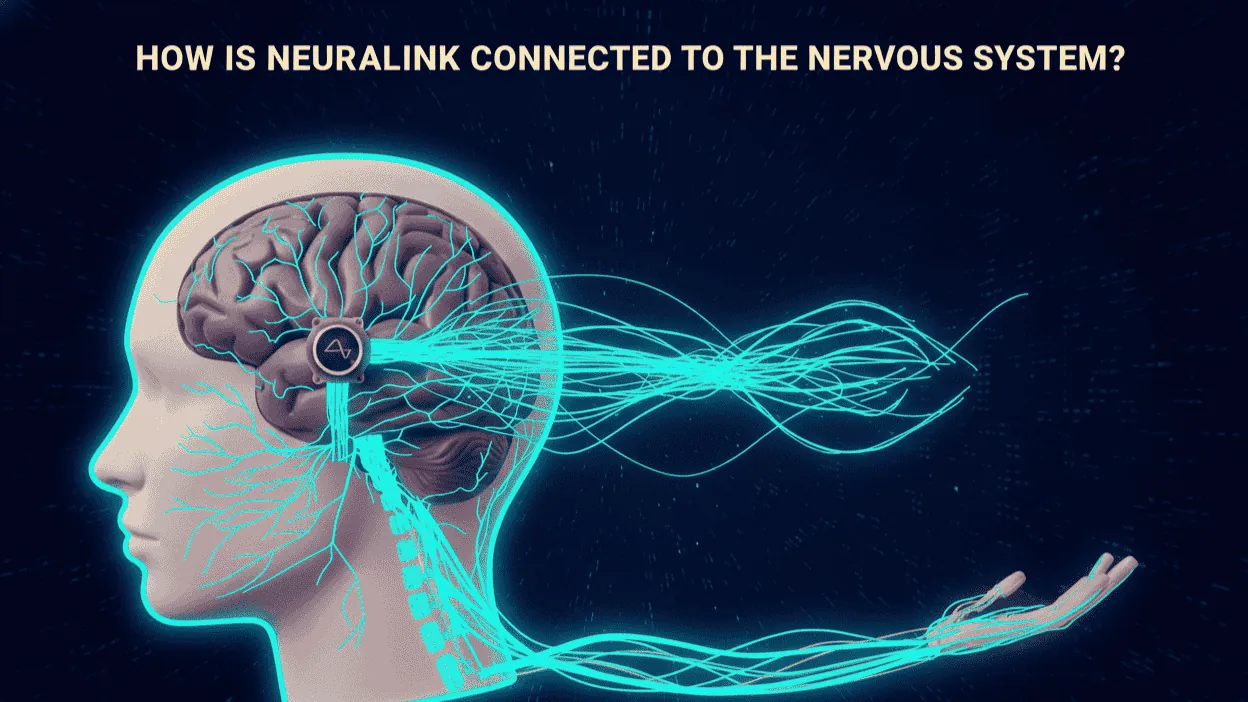
- Neuralink connects to the nervous system through ultra-thin polymer threads that the R1 robot inserts a few millimeters into the motor cortex, placing 1,024 electrodes near neurons that control movement.
- Each electrode picks up voltage spikes from nearby neurons as they fire, and the implant turns those signals into digital commands for computers or robotic arms.
- Recent human trials have reached cursor control speeds that match able-bodied mouse users.
The N1 implant: threads and electrodes
The N1 implant is a coin-sized device that holds custom chips and fits flush in the skull under the scalp. Early implants used 64 flexible threads with 16 electrodes each, and later ones use 128 thinner threads with 8 electrodes each, for 1,024 recording sites either way, according to the PRIME brochure and Neura Pod's Neuralink FAQ. The threads are thinner than a human hair and made of a flexible polymer, so they move with the brain as it shifts with breathing and pulse.
The threads go into the motor cortex, the part of the brain's outer layer that plans movement. Neurons there fire electrical spikes when a person intends to move, and the electrodes record those spikes from the outside of the cells.
Neuralink's roadmap called for about 3,000 channels in 2026 and about 10,000 in 2027, and a 3,000-channel implant was disclosed in September 2026.
The R1 robot and the surgery
The implant has to be placed precisely, avoiding blood vessels. Thread insertion by the R1 robot is one step of a surgery performed under general anesthesia that currently takes a few hours. A neurosurgeon removes a small disc of skull, and the robot uses cameras to map the surface of the brain and plan paths around the vessels. A needle then pushes each thread a few millimeters into the cortex and pulls back, leaving the flexible thread in place. The implant fills the opening in the skull, and the scalp closes over it. The battery charges wirelessly.
The first patient, Noland Arbaugh, was moving a cursor by thought soon after his January 2024 implant, and the UK's first patient, Paul, controlled a cursor hours after his surgery in October 2025.
Reading neuron signals
Neurons communicate through action potentials, brief voltage spikes that last about 1 millisecond. Electrodes outside the neuron pick up these spikes as microvolt-scale signals, which the implant amplifies. Its chips digitize each channel thousands of times per second and send the data over Bluetooth to a phone or computer, where machine learning decoders map spike patterns to intentions, like moving a cursor to the right.
Second patient Alex Conley uses the implant's recorded signals to control a robotic arm in the CONVOY Study. The chip can also deliver small electrical pulses, and Neuralink plans to use stimulation in Blindsight, its vision implant, which had not started human trials as of October 2026.
Neuralink participants have reached up to 11.32 bits per second, above the 8 to 10 bits per second typical of able-bodied mouse users, according to Neuralink's October 2026 update.
Thread stability and safety
In Noland's implant, brain motion pulled many of the threads out of the tissue in 2024. Neuralink changed its software to restore his performance without surgery. After changes made following Noland's surgery, Neuralink reported higher signal quality in 18 of the next 20 participants and says it is still improving thread retention. Neuralink reported zero serious device-related adverse events across 21 participants as of January 2026. Flexible threads are meant to cause less scarring than rigid arrays like the Utah array.
Upgrades and the long-term goal
In November 2025, Elon Musk shared a report that Noland hopes to receive a second implant below his spinal injury to help restore leg movement. Musk's longer-term goal is a link fast enough for people to work directly with AI.
This article was first published in October 2025 and corrected in October 2026; the latest patient count is on the patient table.








