
Neuralink Long-Term Goals: Beyond Medicine Explained
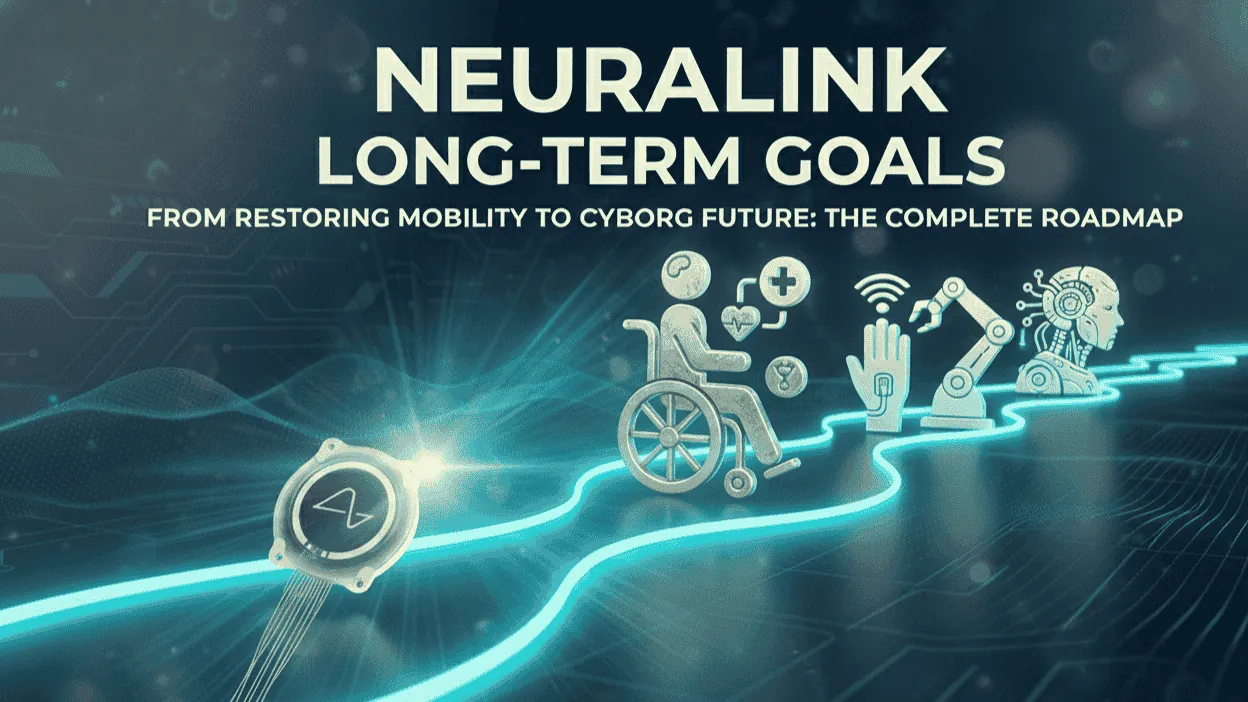
- Neuralink's main long-term goal beyond medicine is a high-bandwidth brain-computer interface that lets human intelligence keep pace with artificial intelligence.
- Elon Musk has described future uses such as direct thought-to-thought communication and faster interaction with AI systems.
- The company's planned products include Blindsight for vision and robotic control by thought, building on its current Telepathy device.
From restoration to enhancement
Neuralink began with a medical focus: its N1 implant helps people with paralysis control computers and phones using only their thoughts. As of late October 2025, 13 people had received implants: 10 in the United States, 2 in Canada, and 1 in the United Kingdom. Neuralink reported 21 participants on January 28, 2026. These patients, including Noland Arbaugh and Paul, use the Telepathy device to browse the web, play games, and, in some cases, control robotic arms.
Elon Musk co-founded Neuralink in 2016. Early demonstrations showed monkeys playing Pong, and human participants controlled cursors shortly after surgery. Regulators in the US and the UK have approved human trials, and the CONVOY study now tests robotic arm control.
Musk has always described goals that reach past medicine. In November 2025, he shared a report that Noland hopes to receive a second implant below his spinal injury to help restore leg movement.
Human and AI symbiosis
Musk argues that AI will soon surpass human thinking and that people without a direct interface risk falling behind. Neuralink's stated aim is a "general-purpose, high-bandwidth" link between the brain and computers.
The implant records from 1,024 electrodes on flexible threads thinner than a hair. Musk has said Neuralink raises the probability of a good outcome with AI above zero, and he has floated ideas such as learning new knowledge far faster than reading. He also ties the goal to exploration, saying a closer link with AI would help humanity understand the universe and support life on other planets.
Telepathy and mind-to-mind links
Telepathy is the name of Neuralink's first product, which turns thought into control of digital devices. Musk has also talked about human-to-human telepathy, in which ideas could pass between people without speaking or typing. None of that has been tested.
Early patients already achieve mouse control at speeds matching able-bodied users, and a Neuralink participant set a brain-computer interface record of 11.32 bits per second in 2026, according to Neuralink's October 2026 update. Musk predicts recipients will one day outperform able-bodied players in fast video games like first-person shooters.
Blindsight and the senses
Neuralink has trademarked names including Telepathy, Telekinesis, and Blindsight. Blindsight would stimulate the visual cortex to give blind people a basic form of sight, bypassing damaged eyes or optic nerves. It received an FDA Breakthrough Device Designation in September 2024, but no human trial had launched as of October 2026. Musk has said later versions could exceed normal vision, for example by seeing in infrared.
Robots and the physical world
In the CONVOY study, patient Alex Conley was the first to control a robotic arm. Musk has described "telekinesis," another trademarked term, in which users would control robots, drones, or exoskeletons by thought, and he has linked that idea to Tesla's Optimus robots.
This article was first published in October 2025 and corrected in October 2026; the latest patient count is on the patient table.








