
What Else Can Patients Do with Neuralink Implants? Capabilities Listed
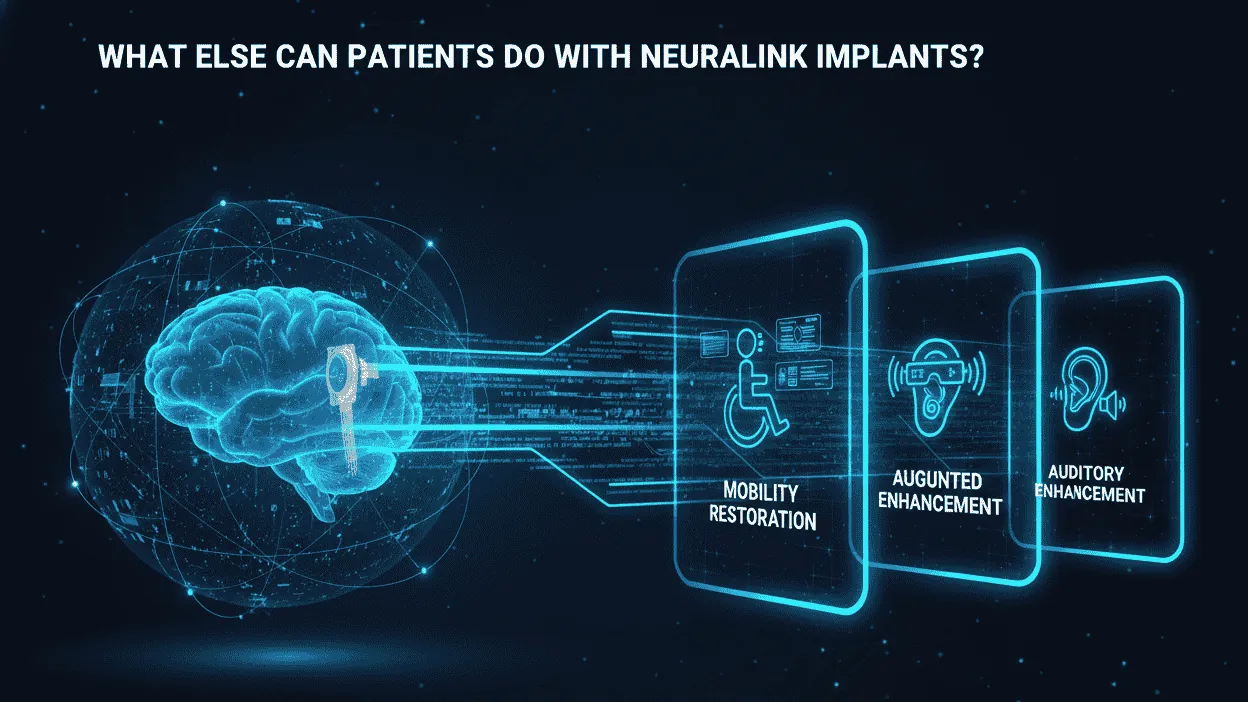
- Neuralink patients control robotic arms by thought to feed themselves and drink from cups.
- They play video games with precise cursor control that rivals able-bodied players.
- Patients type, browse, study subjects like calculus and neuroscience, and in 2026 began driving wheelchairs and speaking through the implant.
Update, October 2026: Since this article was first written, Neuralink showed participants driving wheelchairs with the implant (July 2026), and the VOICE speech trial produced its first results: Kenneth Shock appeared in a Neuralink video in March 2026, and Terence (Terry) Mandable spoke with a voice decoded from his brain in September 2026. Audrey Crews makes art with her implant, and CJ, patient 24, uses it for CAD work. See the July 2026 and September 2026 updates.
Computer control
Neuralink implants let people with quadriplegia or ALS operate computers by thought. The N1 device records signals from 1,024 electrodes in the motor cortex and turns them into cursor movements. First patient Noland Arbaugh, implanted in January 2024, was using his implant about 10 hours a day by August 2025.
Participants use apps, browse the web, and post on social media. They have typed at up to 40 words per minute by imagining finger movements, according to Neuralink's January 2026 update. Neuralink says users averaged 55 minutes a week of calibration, and its 2026 decoder update cut that to as little as 10 minutes a week for some users.
Video games
Patients also play games that need fast inputs. Arbaugh has played games from Pong-style tasks to first-person shooters by thought. Elon Musk has predicted that recipients will one day outperform most people in fast-reaction games.
The median participant reaches about 10 bits per second on Neuralink's cursor test, matching able-bodied mouse users, and one set a record of 11.32 bits per second, according to Neuralink's October 2026 update.
Robotic arms
In the CONVOY study, participants direct robotic arms for real-world tasks. Alex Conley was the first to control one, and ALS patient Nick Wray feeds himself and drinks from cups with the arm. The implant decodes intended movements in several directions at once and maps them to the arm's joints.
Study and work
Arbaugh studies pre-calculus and neuroscience and gives keynote talks, using the device for his presentations. Participants also edit documents and make video calls. Participants have streamed over 50,000 hours of neural data, according to Neuralink.
Speech and vision
Neuralink's speech work has an FDA Breakthrough Device Designation, and the VOICE trial began implanting participants in early 2026. Blindsight, a planned vision implant, would stimulate the visual cortex using camera input; it has not started human trials.
Musk has talked about abilities such as infrared vision in the future. After changes made following Noland's surgery, Neuralink reported higher signal quality in 18 of the next 20 participants and says it is still improving thread retention. Internal projections reported by Bloomberg target 20,000 implants a year by 2031.
This article was first published in October 2025 and corrected in October 2026; the latest patient count is on the patient table.








