
Neuralink vs Other BCIs: Key Comparisons and Differences
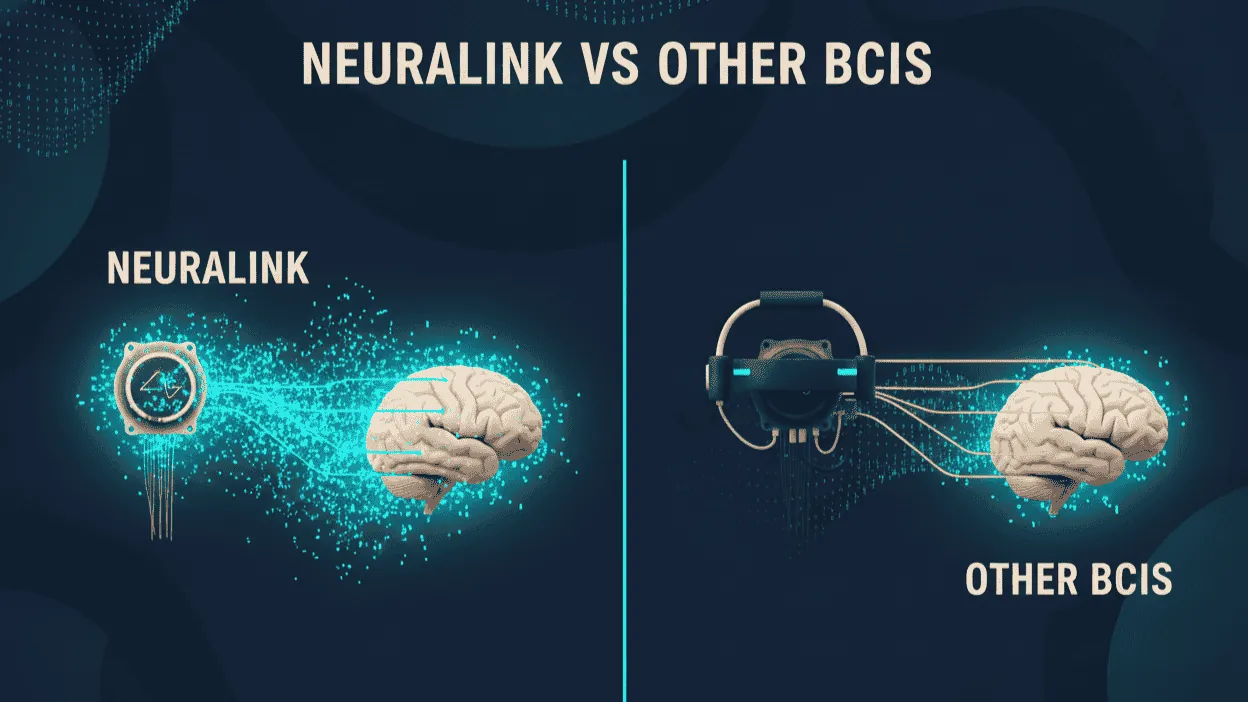
- Neuralink's N1 implant, with 1,024 flexible electrodes, delivers typing speeds of up to 40 words per minute and more channels than Synchron's 16-channel stent or Blackrock's Utah Array.
- The N1 is fully implanted and wireless, avoiding Blackrock's skin-penetrating connector and the blood vessel placement Synchron uses.
- Neuralink had 13 implants across three countries by late October 2025, more long-term human data than Paradromics or Precision Neuroscience at that time.
How the designs differ
Neuralink's N1 implant places 1,024 electrodes on flexible threads in the motor cortex: 64 threads in early implants and 128 thinner threads in later ones. The design captures fine-grained neural signals for cursor control, typing, and robotic arm operation.
Synchron's Stentrode carries 16 electrodes on a stent placed inside a blood vessel, which avoids open brain surgery but limits resolution. Blackrock Neurotech's Utah Array uses 96 to 128 rigid silicon spikes that go into the cortex; it has decades of use but its signals can degrade. Paradromics' Connexus has 421 electrodes; its first long-term patient was implanted in June 2026. Precision Neuroscience's Layer 7 Cortical Interface matches Neuralink's 1,024 channels on a thin film that lies on the brain surface.
Neuralink can update its software remotely to improve performance.
Surgery: precision against invasiveness
Neuralink uses the R1 surgical robot to insert the threads through a small opening in the skull. The fully implantable system has no external wires, so participants can shower and sleep normally. Neuralink reported zero serious device-related adverse events as of January 2026.
Synchron threads its device in through the jugular vein without opening the skull and had implanted 10 patients by mid-2025. Blackrock needs a craniotomy plus a pedestal, a connector through the skin for wired data, which carries an infection risk over years. Paradromics and Precision use craniotomies: Paradromics for penetrating electrodes, and Precision for surface placement, cleared for up to 30 days.
Neuralink's robot is meant to reduce variation between surgeons as the trials grow. Its sites include Barrow Neurological Institute, the University of Miami, Toronto, and London, with a UAE site recruiting.
Speed and control
Neuralink participants reach a median of about 10 bits per second and a record of 11.32 bits per second, and have typed at up to 40 words per minute, according to Neuralink's October 2026 update. Noland Arbaugh was using his implant about 10 hours a day by August 2025 for gaming and design.
Synchron enables basic clicking and iPad use but is slower because of its few channels. Blackrock arrays have supported arm control and speech synthesis, and long-term users like Nathan Copeland have felt touch through stimulation. Paradromics has claimed over 200 bits per second in preclinical benchmarks and is targeting speech. Precision has focused on brain mapping during surgery.
Clinical milestones
Neuralink's trials run in the US, Canada, and the UK, with CONVOY adding robotic arms and VOICE testing speech. Neura Pod's patient table lists 27+ publicly known patients as of October 2026.
Synchron's COMMAND trial showed its device could be used safely in people with paralysis. Blackrock users have kept implants for more than 10 years. Precision implanted 37 times by mid-2025, mostly during neurosurgery. Paradromics' first long-term patient produced real-time speech in September 2026, as covered in Neura Pod's September 2026 update.
Scaling up
Neuralink is expanding its speech trial and plans a Blindsight vision trial. Its vertical integration, from the robot to the app, is built for higher production. Jon Noble, a UK participant, wrote in December 2025 that more than 10,000 people were on the US waiting list.
This article was first published in October 2025 and corrected in October 2026; the latest patient count is on the patient table.








