
Veterans and Neuralink: A Second Chance for Those Injured in Service
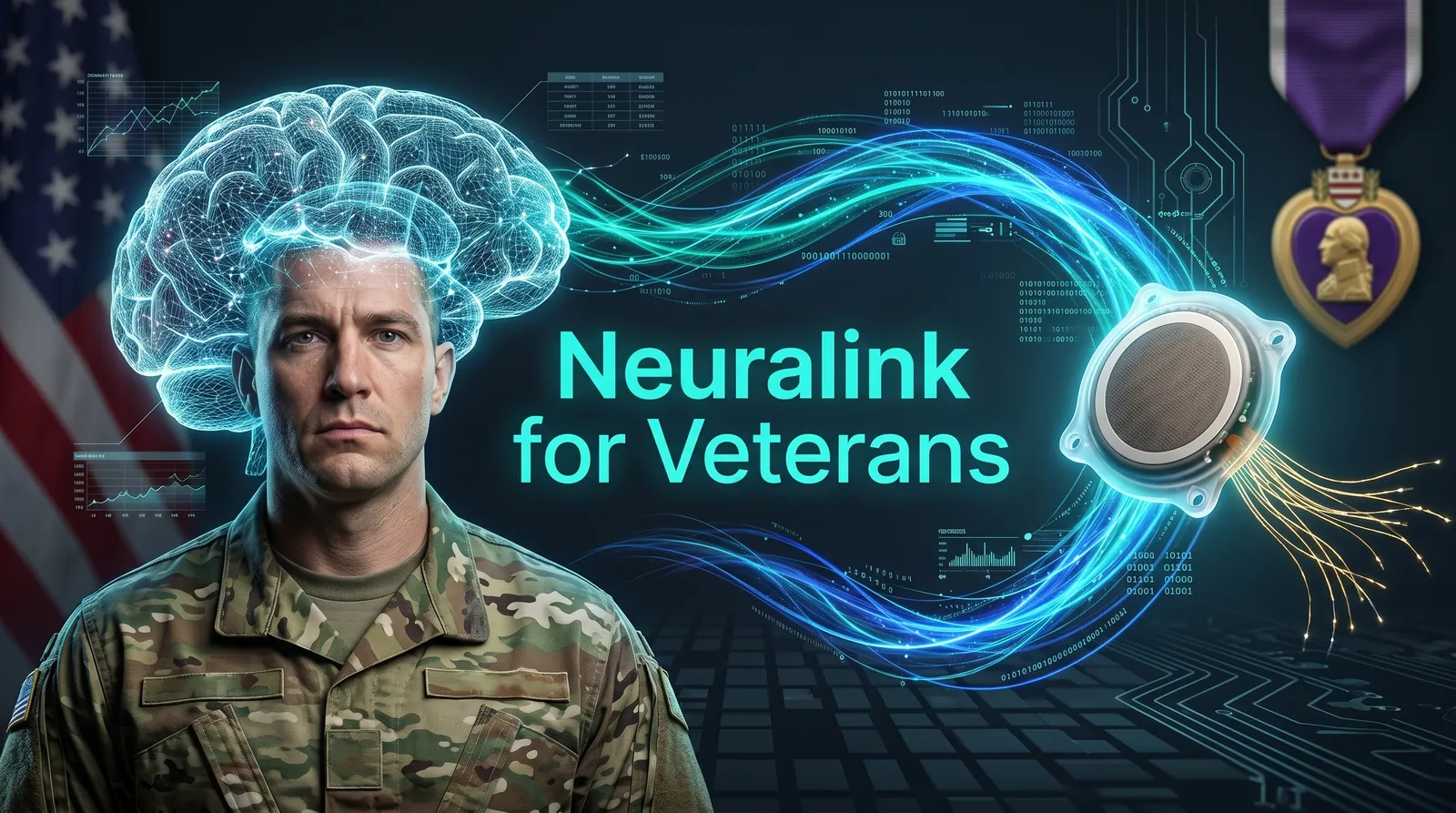
- The VA manages a registry of more than 38,000 US veterans with spinal cord injury or disorder, with roughly 450 new service members receiving SCI rehabilitation each year.
- Veterans also disproportionately carry traumatic brain injury (TBI), blast-related neurological damage, and ALS, all conditions Neuralink has publicly targeted.
- If Neuralink scales through 2026 and beyond, veterans may be among the first at-scale populations to receive implants, given the VA's existing infrastructure and priority for service-connected disabilities.
A population uniquely affected
US veterans face a neurological and physical injury burden most civilians never encounter. The Department of Veterans Affairs maintains a modernized registry of 38,022 veterans with spinal cord injury or disorder, and about 450 newly injured service members receive rehabilitation at VA SCI centers each year. Roughly a quarter of veterans with traumatic SCI also have a traumatic brain injury, a combination that makes rehabilitation harder and raises lifetime care needs.
Beyond SCI and TBI, veterans develop ALS at more than twice the rate of the general population, a pattern documented consistently enough that the VA recognizes ALS as a presumptive service-connected disability. Vision loss from blast exposure, severe chronic pain, and PTSD-linked sensory disorders round out a profile of conditions that Neuralink has, at different points, identified as within scope for current or future products.
Why veterans are a natural early population
Three structural factors make veterans one of the most realistic at-scale populations for early Neuralink adoption.
The first factor is infrastructure. The VA already operates 25 dedicated Spinal Cord Injury and Disorder Centers nationwide, supported by more than 130 regional primary care teams. That's an existing clinical network that can evaluate candidates, manage follow-up, and provide long-term care, something no civilian hospital system currently matches at similar scale.
The second is coverage. Service-connected disabilities are covered through the VA, removing the single biggest barrier civilian patients face: cost. If automated surgery and higher production volumes lower costs, the VA is well-positioned to underwrite implants for qualifying veterans without the insurance fights that define civilian access to advanced medical devices.
The third is precedent. The VA has historically led adoption of advanced rehabilitation technologies, such as powered exoskeletons, prosthetic limbs, and assistive robotics, because its patient population's needs and its budgetary authority align. A brain-computer interface is the logical next step in that progression.
What a Neuralink offers the post-injury veteran
For a veteran paralyzed in combat or training, the most immediate benefit of a Neuralink is direct digital autonomy. The PRIME study has already shown that quadriplegic patients can operate computers, smartphones, and assistive devices with only their minds.
First @Neuralink product will enable someone with paralysis to use a smartphone with their mind faster than someone using thumbs
— Elon Musk (@elonmusk) April 8, 2021
For veterans whose professional lives were interrupted mid-career, that access alone reopens pathways to remote work, continued education, and engagement with veteran advocacy networks. For those who lose speech after a service-connected injury, the VOICE trial shows a parallel path toward restored communication.
Restoring movement
Where Neuralink goes further than most rehabilitation technology is in its long-term vision to bridge the spinal cord. Elon Musk has publicly described the intent to connect brain-implanted Neuralinks with implants below the injury site, restoring voluntary muscle control without requiring the damaged segment of the spinal cord to heal.
Later versions will be able to shunt signals from Neuralinks in brain to Neuralinks in body motor/sensory neuron clusters, thus enabling, for example, paraplegics to walk again
— Elon Musk (@elonmusk) April 8, 2021
For a veteran who lost mobility in service, the shift from an assistive interface to reconnective therapy would mean recovering from paralysis instead of adapting to it. It's also the specific ambition that makes veterans, who often have traumatic injuries with otherwise intact nervous systems above and below the damage, strong clinical candidates.
TBI, blast injury, and memory
The other large veteran-specific opportunity is traumatic brain injury. Hundreds of thousands of post-9/11 service members have sustained some form of TBI, primarily from blast exposure. While Neuralink's current trials don't directly address cognitive rehabilitation after TBI, Elon Musk has publicly listed memory restoration, seizure control, and brain damage recovery as future targets. Any success in those areas would have immediate and disproportionate impact on veteran populations.
The path from trial to scale
A realistic path for veterans to receive Neuralink likely runs through a few gates. First, continued safety and efficacy data from PRIME and VOICE through late 2026. Second, a formal partnership or procurement pathway between Neuralink and the VA, which would be routine, since the VA regularly buys advanced medical devices on service-connected need. Third, dedicated veteran-focused trial sites, likely in cooperation with existing VA SCI centers.
International precedent already exists for expanding Neuralink beyond the initial US trial pool: PRIME has active satellite sites in Canada (CAN-PRIME) and the UK, showing the company's willingness to scale across health systems. A VA partnership would be a comparatively small additional step given the infrastructure.
Who it could reach first
Candidates to watch as Neuralink expands into the veteran population include:
- Post-9/11 veterans with cervical SCI from combat injury or training accidents.
- Veterans with service-connected ALS, a population the VA already prioritizes for advanced rehabilitation trials.
- Veterans with severe blast-related vision loss, as potential Blindsight program candidates.
- Combat-injured veterans with concurrent TBI and SCI, whose rehabilitation needs span multiple Neuralink product lines.
Summary
Veterans carry one of the highest combined burdens of paralysis, TBI, ALS, and blast-related neurological injury of any population in the world. They also have access to a uniquely capable health system, the VA, with the infrastructure, coverage, and institutional precedent needed to support advanced neurotechnology adoption.
If Neuralink achieves its late-2026 scaling goals, service members injured in the line of duty could be among the earliest populations to receive implants at meaningful volume. For the roughly 38,000 veterans currently in the VA's SCI registry, the remaining questions are timeline, procurement, and political will.








